
Overview
An objective, high-fidelity measure of cardiopulmonary functional capacity.
CPET is the gold standard for measuring peak VO2 in patients with cardiovascular disease, but it requires specialized resources and a strenuous exercise protocol that many patients cannot safely complete. eVO2peak replaces that test with a continuous, at-home estimate built from routine activity.
- Estimation of peak VO2 from ECG and vital-sign dynamics during activities of daily living — no strenuous activity required of the patient.
- Generates an eVO2peak estimate from each sliding 7-day window of patch data, enabling daily trend analyses.
- Replaces the 6-minute walk test, a low-resolution CPET substitute used ubiquitously in trials.
- Provides additional insight between standard CPETs, enabling a better understanding of trends and variability.
Validation cohort
262
Participants
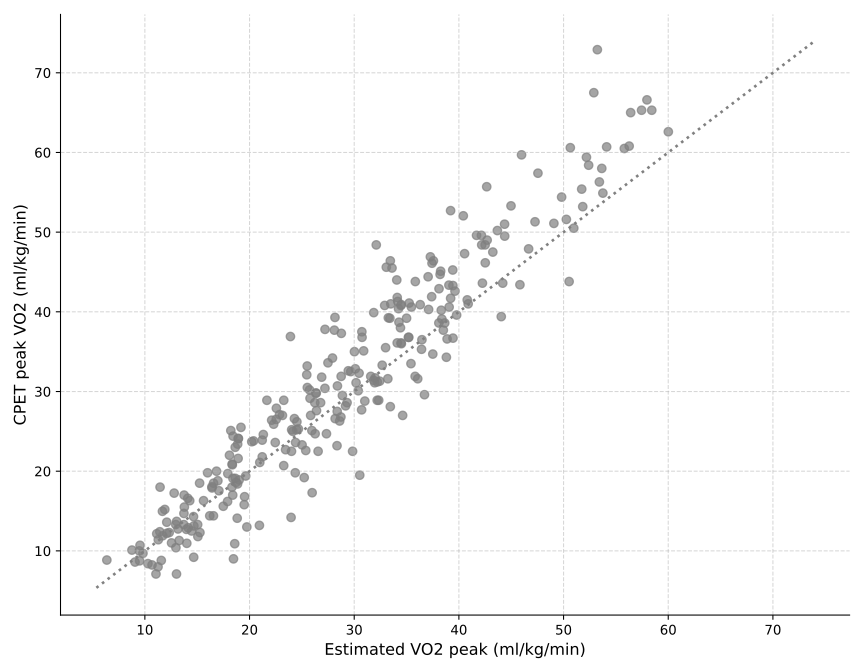
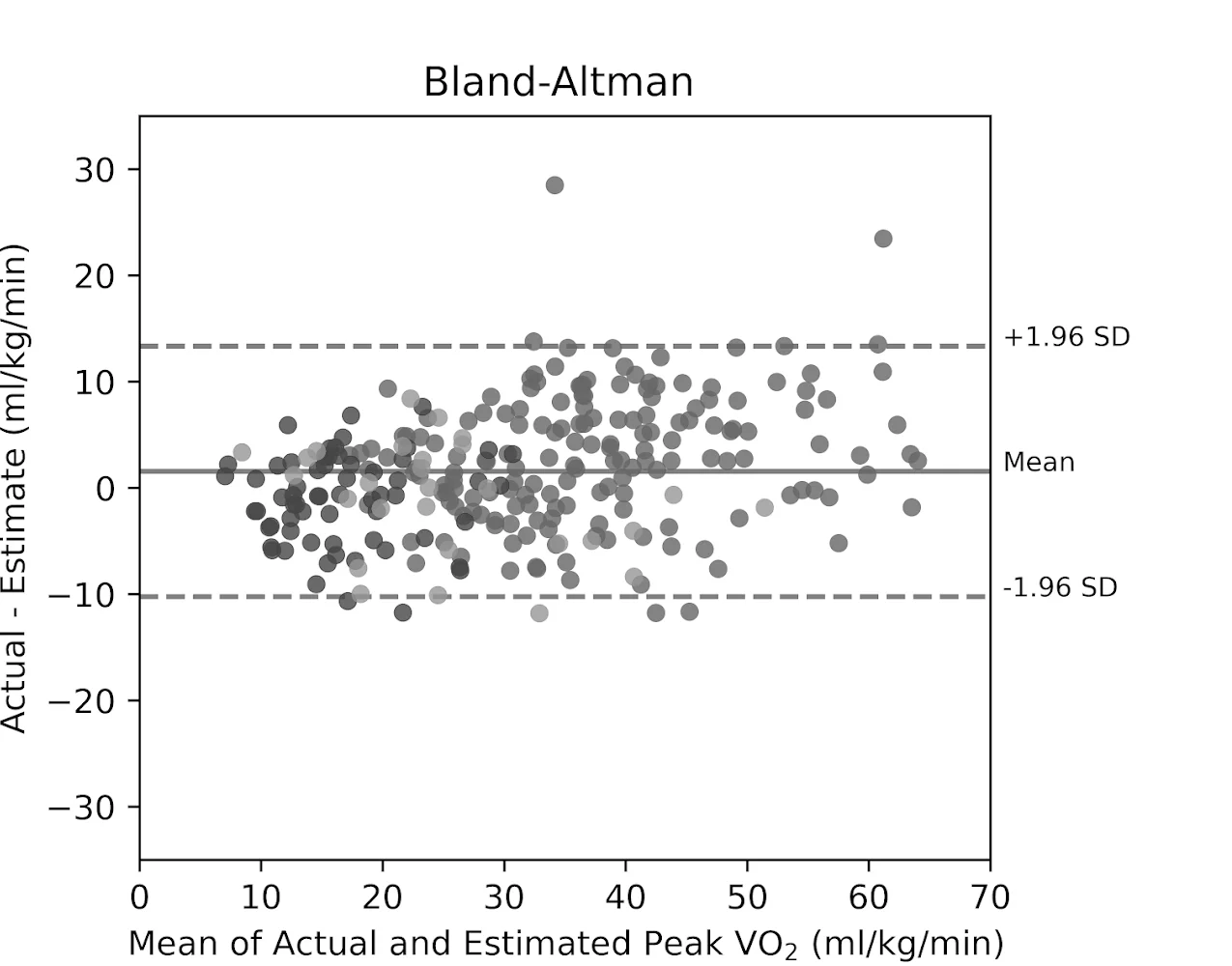
Healthy participants, patients undergoing standard-of-care CPET, and patients with heart failure. eVO2peak correlated with CPET peak VO2 across a wide range of peak VO2 values.
eVO2peak vs. CPET-derived VO2 Peak
Bland–Altman agreement plot.
Clinical outcomes
Early changes in eVO2peak predict outcomes in heart failure.
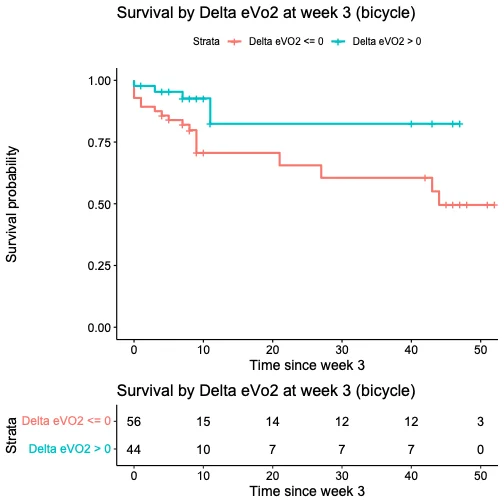
In patients with HF, changes in eVO2peak within three weeks of hospital discharge were associated with subsequent risk of unplanned hospitalization, ER visit, or death. Bicycle CPET modality.
-
p = 0.0208
Associated with adverse events post-discharge
Changes in eVO2peak within three weeks of hospital discharge were associated with subsequent risk of unplanned hospitalization, ER visit, or death.
-
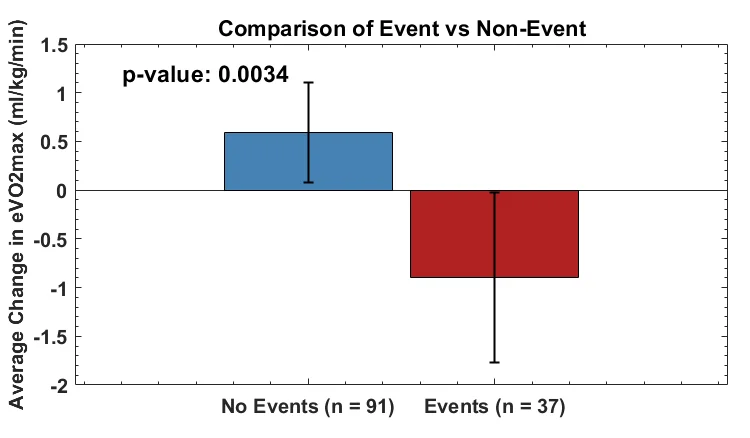
p = 0.0034
Decline tracks with worse outcomes
Patients experiencing adverse clinical outcomes tended to show decreased — vs stable or increased — eVO2peak from weeks 1 to 3 post-hospitalization.
Event vs. no-event groups (p = 0.0034)
Survival by Δ eVO2peak at week 3
CPET vs eVO2peak
Continuous, at-home insight in place of a strenuous lab test.
Many patients cannot safely perform maximal exercise tests. eVO2peak is derived from routine activity, making it suitable for the populations most often excluded from CPET-based endpoints.
Standard CPET
Lab-based stress test
- Requires specialized clinic equipment and trained staff.
- Strenuous exercise protocol — not safe for many patients.
- Often unsuitable for elderly, advanced HF, pulmonary disease, or frail populations.
- Typically yields 2–3 measurements over the course of a study.
eVO2peak
Continuous at-home estimate
- Derived from routine activity — no strenuous exertion required.
- Suitable for elderly populations, advanced HF, pulmonary disease, and frail patients.
- Dozens of objective functional measurements per participant.
- Supports improved endpoint sensitivity, smaller sample sizes, and earlier signal detection.
Active trials
Assessed in Kardigan clinical trials across multiple cardiovascular disorders.
eVO2peak is currently in use as a digital endpoint across three Kardigan-initiated programs, plus Prolaio’s own OCORO Heart Study.
Observational
OCORO Heart Study
Decentralized, at-home cardiovascular cohort capturing continuous real-world data.
NCT07420907
Phase 2/3
KINSHIP-DCM
Symptomatic genetic and familial dilated cardiomyopathy.
NCT07210723
Phase 2/3
KATALYST-AV
Moderate calcific aortic valve stenosis.
NCT07001800
Phase 2
KARDINAL
Uncontrolled hypertension.
NCT06864104