
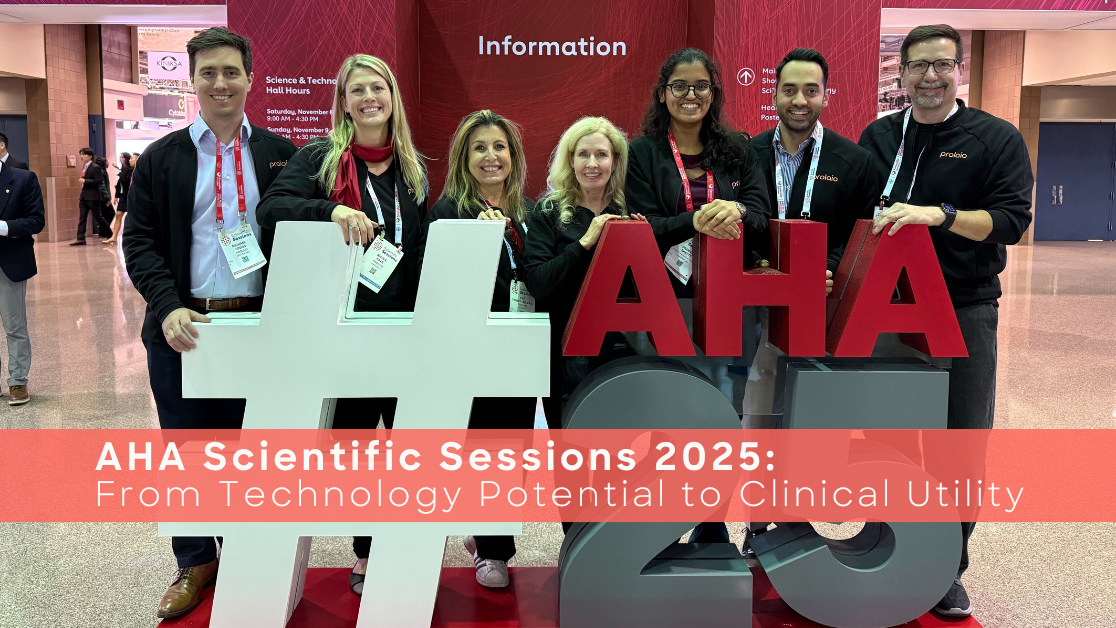
AHA Scientific Sessions 2025: From Technology Potential to Clinical Utility
There are conferences where you capture information. And then there are conferences that spark inspiration.
The other week, our team spent three days at the American Heart Association’s Scientific Sessions in New Orleans, immersed in late-breaking science, tech showcases, and spontaneous hallway dialogue with researchers and clinicians from around the world.
What stood out wasn’t one presentation, but a shared mindset that echoed through poster halls, panel stages, and coffee-line conversations:
“It was clear in multiple conversations and contexts that the AHA and cardiology in general are not only interested, but willing, to put work toward the democratization of care. This includes shared decision-making and decentralized care with the potential to bring more patients into the fold and allow them to take more ownership of their disease journeys.”
- Greg Kurio, Prolaio Chief Medical Officer
The future of cardiology has never felt closer, and we couldn’t be more excited to share the takeaways that truly stayed with us.
3 Key Takeaways from AHA 2025
Before we dive in, one idea kept surfacing throughout the entire conference: technology only matters when it informs a clinical decision. This year, the focus was on the:
- therapies born from new technologies (e.g., next-gen lipid agents, siRNA, long-acting injectables), and
- the data pipes that shrink the gap between signal → insight → timely action.
These themes cut across drug development, diagnostics, AI, and clinical operations—all pointing to faster, clearer decision-making.
1. Therapies: Shift to Primary Prevention
Among many late-breaking studies, two stood out for pre-event intervention in high-risk patients, with encouraging outcome signals:
- VESALIUS-CV: Adding evolocumab to standard therapy in high-risk adults without prior MI or stroke reduced the incidence of the first major cardiovascular event over ~4.5 years — a real move into primary prevention.
- CORALreef Lipids (enlicitide, oral PCSK9): Once-daily enlicitide achieved ~55–60% LDL-C reduction at 24 weeks and ~48–52% sustained reduction at 52 weeks with a placebo-like safety profile. Outcomes are pending, but the oral route could expand upstream use beyond injectables.
2. Real-World Data: Continuous Signals Between Visits
Self-applied patches, home-shipping, and remote onboarding showed high compliance and clinically usable data at scale. The win isn’t data volume. It’s removing the silent gaps between clinic visits where disease actually progresses. Here are some of the examples of large-scale home activation:
- Zio home-enrollment (large-scale home activation): of 742,268 long-term continuous ECG patches compared home self-application vs in-clinic. Results: median wear ≈ 13.8 days, >98% analyzable ECG time, early terminations ≤2%, with higher in-app engagement in the home cohort—supporting continuous monitoring and remote activation as standard practice.
- Wearable defibrillator ACE-PAS (AHA25, real-world LBS): 21,612 patients; 100% VT/VF conversion (primary effectiveness endpoint met), inappropriate-shock rate 0.0065 per patient-month, 94% with no false shock alarms, and median wear >23 h/day—showing connected, real-world monitoring that directly supports treatment decisions in a high-risk window.
3. Workflow: Proactive Interventions Before Events
Two things stood out in heart failure: simplifying what patients actually take and acting before decompensation.
- HF polypill to boost adherence and outcomes. A late-breaking HFrEF study reported that a single-pill combination (vs the same meds as separate pills) drove higher LVEF (~+3% absolute), markedly fewer HF hospital/ED visits, better quality of life, and improved adherence at ~6 months — a pragmatic path to closing the guideline-use gap.
- The multicenter LINK-HF study was highlighted as an example of how AI can augment HF care. Originally published in 2020, the study evaluated a version of Prolaio’s cleared personalized modeling technology, which uses a machine learning-based Digital Twin built from continuous ECG-patch wearable data. After hospital discharge, the model, trained for each patient, enabled detection of impending heart-failure decompensation approximately 6.5 days before symptom onset. This study suggested that the use of the Digital Twin technology in HF patients could allow clinicians to adjust medications or care plans to prevent, rather than react to, adverse clinical events.
“It has been a pleasure collaborating with Dr. Stehlik and his team at the VA over these many years. The continued interest in the LINK-HF work, as highlighted at AHA25, further validates our mission to develop and apply ML-based techniques for continuously monitoring HF patients with the potential to improve clinical outcomes and quality of life.”
– Stephan Wegerich, Prolaio’s Chief Science Officer
Continuous → Actionable → Clinically Meaningful
AHA 2025 made one thing clear: technology that doesn’t inform a decision is noise. We saw therapies moving prevention upstream, remote workflows that keep data flowing between visits, and AI that earns its place by triggering timely action. For teams like ours at Prolaio, the mandate is practical: integrate continuous signals, surface only what matters, and close the loop with the care team—so the next right action happens before the event, not after it.